Published research · Iftekhar Ahmed and Omar Farrok
SwingBoard
A swipe-based keyboard for blind and visually impaired smartphone users.
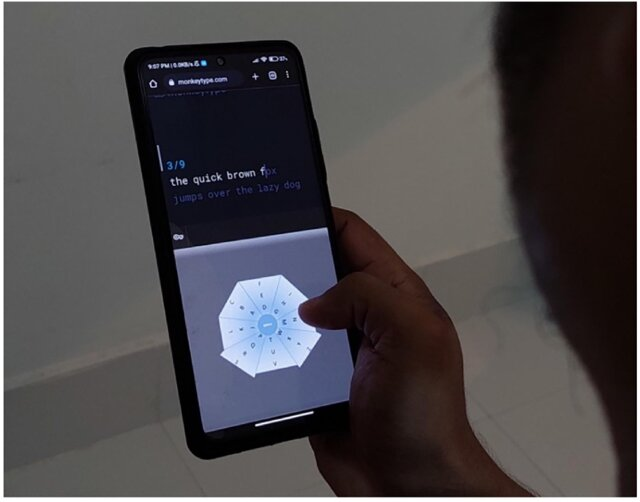
SwingBoard turns the direction and length of a swipe into a key press. It explores how people can type on a touchscreen without having to locate each small key visually.
Why it matters
Typing is part of everyday phone use: sending a message, looking something up, or entering information into an app. For someone who cannot see the keyboard, finding individual keys can add work to every one of those tasks.
My interest in this problem grew out of Brailly and making reading and computing more accessible. SwingBoard focuses on one part of that experience: entering text through a gesture that can be learned and repeated.
How it works
The keyboard maps swipe angle and distance to letters, numbers, punctuation, symbols, and keyboard functions. Its layout uses eight angular zones and four segments, with two modes and additional gestures.
The design supports one- or two-handed use. Haptic feedback, spoken feedback while swiping, and adjustable swipe length help users learn and operate the layout. The interaction depends on movement rather than visually selecting a small target.
What the study found
The published study evaluated seven blind participants. After 150 one-minute tests, it reports an average typing speed of 19.89 words per minute with 88% accuracy.
These results describe that study and its testing conditions. A seven-person evaluation cannot establish how well the keyboard would work for every user, device, or accessibility need. It also does not establish a universal advantage over other keyboards.
Publication
Iftekhar Ahmed and Omar Farrok. SwingBoard: introducing swipe based virtual keyboard for visually impaired and blind users. Disability and Rehabilitation: Assistive Technology, 19(4), 1482–1493. Published online April 25, 2023; print issue May 2024.
The paper lists BRAC University and Ahsanullah University of Science and Technology as the authors’ affiliations at publication.
Read the paper ↗ · PubMed record ↗
The University of Würzburg HCI group also references SwingBoard in its research topic on eyes-free text entry in VR. This is a reference to our paper, rather than a collaboration on that project.